Viewpoint

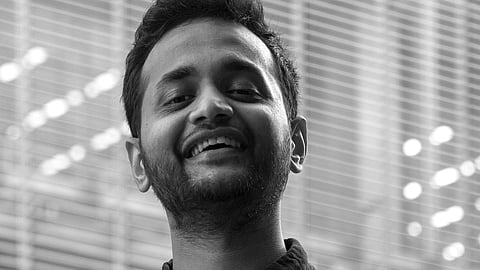

Internships are often seen as a way to gain experience, build portfolios, and step closer to the industry. But as Harshal Duddalwar reflects, their real impact is quieter and more gradual. Shaped by environments, conversations, and ways of working, internships become less about immediate outcomes and more about learning how to think, question, and slowly understand one’s place within design.
Looking back at your internships, both in India and internationally, when did you first feel your design identity begin to take shape? Was it gradual, or triggered by a specific moment?
It was definitely gradual. I didn’t enter design with a very clear intention; I was initially preparing for medical school, so my relationship with design was more exploratory than decisive. Internships became a way for me to understand the field from the inside. During my undergraduate studies, I consciously chose to work across different disciplines–branding, illustration, product, systems, because I didn’t yet know what felt natural to me. Each of those experiences gave me a slightly different lens on what design could be.
Looking back, I don’t think identity arrived at a single moment. It was more about the accumulation of environments, people, and ways of working. Even something as subtle as how a team critiques or how a file is structured starts to influence how you think. Over time, these *fragments* begin to align, and that’s when a sense of identity starts to form.
Your work spans branding, editorial, systems, typography, and speculative thinking. Do you think internships helped you discover this range, or did they refine something that was already there?
I believe they approached it in different ways over time.
In the beginning, internships focused on exploration. I aimed to understand the scope of graphic design, what it entails, how various studios interpret it, and where I might fit within that landscape.
Over time, those same experiences started to feel less like exploration and more like refinement. I began to notice recurring interests, systems, structure, simplicity, and internships helped me see how those could take different forms depending on context.
So while I wouldn’t say internships alone defined that range, they played a crucial role in bringing it into focus. They allowed me to test instincts I didn’t yet fully understand.
Do you think interns focus too much on building a portfolio and not enough on building a point of view?
I think it’s a natural phase. As a student, you’re often evaluated through what you produce, so there’s a tendency to prioritise how the work looks–how polished or visually compelling it is.
But a portfolio, at its best, is a reflection of how you think. And that’s where the point of view begins to matter. But the thing is, that point of view is slower to develop. It comes from experience, from seeing work in context, from understanding constraints.
So while it’s understandable that students focus on portfolios, I think the shift happens when you begin to ask deeper questions–why this approach, why this form, what is this trying to say.
In many ways, the portfolio is the surface. The point of view is what gives it depth.
You’ve worked with studios like 2x4, Pentagram, The New York Times and Microsoft. Across domestic and international contexts, what differences did you observe in how interns are integrated into thinking versus execution?
From what I’ve experienced, that boundary has become less rigid over time. In some earlier contexts, interns were more focused on execution, but in places like Pentagram and 2x4, they are treated as active contributors to the process. They were involved in sketching, internal reviews, and discussions around ideas; not just production.
Of course, there’s still a distinction when it comes to client-facing responsibility, but internally, the expectation was/ is to think, not just to execute.
I think the most meaningful learning happens when interns are allowed to witness how ideas evolve–how they’re debated, refined, sometimes discarded. That exposure is far more formative than simply completing tasks.
At what point in your journey did you realise design isn’t just about making, but about reading systems, narratives, and power structures? Did internships play a role in that shift?
That realisation came more clearly once I began working professionally, particularly during my time at The New York Times and later at 2x4.
I started to see how design operates beyond the artefact–how it creates continuity, how it frames information, how it carries meaning over time. Systems became less about consistency and more about coherence, focusing on how different parts relate to each other.
At the same time, working in editorial contexts made me more aware of narrative and influence–how design shapes perception, what it chooses to emphasise or omit. It wasn’t a sudden shift, but more of a gradual awareness that design is embedded within larger structures–cultural, informational, even political.
What’s something interns rarely pay attention to in studios, but absolutely should?
I think many interns focus on doing things correctly–meeting expectations, delivering good work - but don’t always take the time to step back and understand the reasoning behind decisions.
There’s often a desire to prove oneself, which can lead to a more task-oriented approach. But some of the most valuable learning lies in observing–how people think, how they arrive at decisions, how they navigate ambiguity.
Another aspect that’s often overlooked is the human side of a studio. How you engage with people, how curious you are, how invested you seem; these things matter more than we sometimes acknowledge.
At a certain level, most people have strong portfolios. What distinguishes someone is how they think and how they relate to others within a shared approach.
Your personal projects - Ponder, Manhattan Mumbai, People Are Like Shapes - feel deeply reflective. Did those seeds begin during your early professional years? How important is it for interns to protect space for personal inquiry alongside client work?
They became more intentional during my MFA at RISD.
Without predefined briefs, I had to look inward for direction. At the same time, I was navigating a new environment as an international student, which naturally led me to reflect on identity, memory, and belonging. I’ve always tended to think and write a lot–to journal, to process experiences; and I think, at RISD, design became a way to externalise that. It allowed me to give form to thoughts that were otherwise quite internal. Over time, I started to recognise patterns in that work. What initially felt personal and isolated began to feel like a consistent thread.
And it’s extremely important for creatives to protect space for personal inquiry.
Client work is shaped by constraints – timelines, expectations, and objectives. Personal work is where you can operate with a different kind of freedom. It allows you to explore questions that don’t have immediate answers or outcomes that aren’t predefined. That space is where your voice begins to emerge. It’s also what sustains you over time, especially in a field that can otherwise become very output-driven.
I think in many ways, personal inquiry is what keeps the practice alive.
Many internships become task-driven. In your experience, what’s the difference between being “busy” and being truly “formed” as a designer? If someone spends months only executing layouts, what might they be missing?
Being busy often means being productive–completing tasks, producing work, staying occupied. Being formed is about developing judgment.
If someone spends months only executing layouts, they may become efficient, but they risk missing the underlying reasoning–why something is structured a certain way, what makes it effective, what could be different.
Especially now, when tools can replicate a lot of execution, the value shifts toward what is harder to automate–taste, intuition, the ability to make decisions with intent. I think the difference lies in moving from doing to understanding.
Having moved across geographies and disciplines, did working internationally change the kinds of questions you ask yourself as a designer? How did that exposure expand your definition of what design can be?
Working across contexts made me more aware of scale and expectation.
In New York, I’ve often worked with clients and teams that have a strong design sensibility and a willingness to push ideas further. That environment encourages you to think more expansively–not just about how something looks, but how it operates, how it influences, how it extends.
Over time, that changes the kinds of questions you ask. It becomes less about referencing what exists and more about defining what could exist.
When you look back at your internship seasons now, what do you understand differently that you couldn’t see then? How important is reflection - journaling, documenting, observing, in that process?
That clarity of thought and communication is just as important as execution, if not more. Earlier, I might have focused more on the output–whether something looked resolved or polished. Now, I see how much value there is in being able to articulate an idea, to connect it to a larger narrative, to explain why it matters.
Someone who can think clearly and communicate that thinking often stands out more than someone who is only technically strong. I’ve come to realise that design is as much about language as it is about form.
If you could redesign internships today, what one structural change would you introduce to help interns build identity, not just skill?
I would place more emphasis on presentation and articulation.
Being able to communicate your ideas clearly, thoughtfully, and with awareness of the room is a skill that compounds over time. It’s not just about showing work, but about framing it. It’s something I’m still developing myself, and something I wish I had practised more deliberately during my early years.
If internships are a “season,” what should young designers make sure they carry forward when that season ends?
A way of thinking, and a way of being. Skills evolve, tools change, but how you approach problems, how you collaborate, how you remain curious–those are the things that stay.
Internships are less about mastering the work and more about beginning to understand yourself within it.
Another thing you should carry–all the email addresses! You never know when you might need them.
