Digital Art
Designing Places You Want to Explore!
Environment artist Vivek Chaurasia on creating places that may not exist, but still feel real enough to step into.

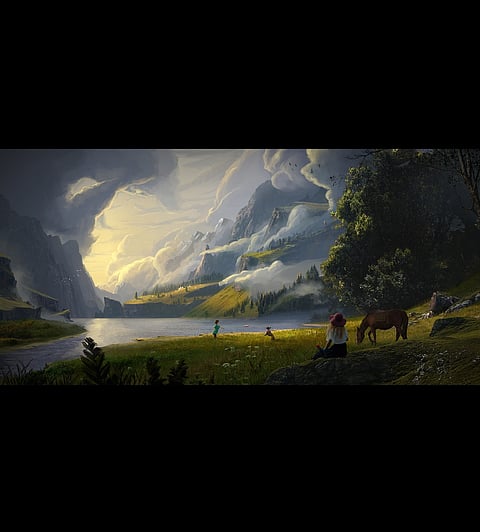

Some artworks impress you with their detail. Others make you wonder what lies beyond the frame. Vivek Chaurasia's environments do exactly that. His towering mountains, forgotten ruins, and atmospheric landscapes feel less like illustrations and more like places waiting to be explored. Rooted in nature yet shaped by imagination, his worlds invite viewers to pause, look closer, and imagine the stories hidden within them. In this conversation, Vivek shares how he balances realism with fantasy, why every environment deserves its own history, and how creating believable worlds begins long before opening any software.
Imagine we could step inside one of your environments for a day. Which world would you take us to, and what do you think we'd discover there that isn't immediately visible in the artwork?
I would probably take you to one of my fantasy landscapes, with towering mountains and peaceful surroundings. It's the kind of place where we could sit, talk, and enjoy the view while wondering what lies beyond the distant mountains. I like creating environments that feel calm and inviting, where people can slow down, explore, and let their imagination wander.
Looking at your work, it often feels like we're arriving in the middle of a story rather than at the beginning. Do you usually start with a narrative in mind, or does the story emerge as you build the world?
It’s a combination of both; most of the time, I know what to create, but sometimes I draw inspiration from other artists' work and real-life references.
Many artists focus on characters, but your work gives equal importance to the places they inhabit. What is it about environments that fascinates you so much?
I always love nature and its mood. What fascinates me is the idea that every environment has a life of its own. I enjoy thinking about who lived there before, how time and weather have shaped it, and what small details can make it feel authentic.
Your worlds feel fantastical, yet believable. How do you balance imagination with realism so that viewers can emotionally connect with places that don't actually exist?
I always start with something that feels real, like a place you could actually imagine existing. Then I gradually add creative shapes, lighting, and atmosphere to give it a sense of another world. I think if the foundation feels believable, people are more willing to accept the fantasy and connect with it emotionally.
Some of your environments feel as though they carry a history of their own. How much do you think about the unseen stories, cultures, or inhabitants behind a place before you begin designing it?
I usually start by collecting references from real-life nature and the work of other artists that inspire me. Those references help me understand forms, composition, and atmosphere, but I don't copy them directly. Once I have that foundation, I begin developing my own ideas by experimenting with perspective, mood, lighting, and design. That's where the environment becomes unique and starts to tell its own story.
There's a strong sense of scale and wonder in your work. What role does scale play in creating emotion, and what do you hope viewers feel when they enter your worlds?
I like creating environments that feel like they belong to another world, places that could exist somewhere, just not in our own reality. I use large mountains, vast landscapes, and dramatic scale to create a sense of wonder and make viewers feel small in comparison. That contrast helps the world feel more immersive, alive, and mysterious. My goal is to make people feel like they're looking at a place they could one day discover, even if it only exists in their imagination.
Looking back at your earlier work, what has changed the most in the way you approach environment design today?
I think experience makes you better in any field, and environment art is no different. As I've grown, my focus has shifted toward creating stronger compositions, better lighting, and a mood that transports me to another world. Instead of just making a beautiful scene, I want to create an environment that feels immersive and believable.
Behind every fantastical world is a blend of imagination and technique. How has your relationship with tools and software evolved over the years, and how do you stop the technical side from overshadowing the creative one?
At the beginning, learning new software was challenging, but with time I became familiar with the basic tools and shortcuts that are essential for creating art. Once those become second nature, I don't have to think about the technical side as much and can focus on being creative.
The creative process often involves pitching ideas and presenting concepts. In your experience as an environment artist, how important is pitching when it comes to getting people to believe in a world that exists only in your imagination?
I think pitching is very important because it provides a detailed context for the artwork, allowing the audience to grasp the underlying vision and intent of the creator.
Finally, what advice would you give to young artists who dream of creating worlds of their own but don't know where to begin?
First, learn the fundamentals, such as perspective, composition, lighting, and colour. It doesn't matter where you learn them, as long as you build a strong foundation. Once you understand the basics, start creating the kind of art you truly enjoy, whether that's characters, environments, or something else.
Don't be afraid to use your imagination and experiment with your own ideas. The more you create, the more you'll develop your own style. Keep practising, stay curious, and most importantly, enjoy the process.
