Architecture
Bridge House in Karjat Reimagines Living as a Passage Through Nature
A thoughtful exploration of landscape, structure, and material by Wallmakers.

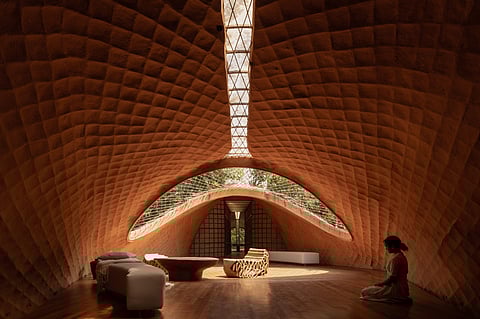

What if a house didn’t sit on land — but crossed it?
In Karjat’s lush, rain-soaked terrain, Bridge House does exactly that. Designed by Wallmakers, the home stretches across the site like a quiet connector, touching the earth lightly while allowing water, wind, and life to move beneath it.
Set in a region known for heavy monsoons, the design responds to water first. Instead of fighting the seasonal flow, the structure lifts itself, forming a bridge across the natural terrain. This gesture is not dramatic - it is practical, poetic, and deeply ecological.
The undercroft remains open. Rainwater finds its path. Vegetation continues to grow. The land breathes.
Rather than cutting and levelling the site, Wallmakers allow the topography to guide the architecture. The result is a linear home that frames views of green valleys while quietly hovering above them.
Karjat’s climate is intense - heavy rainfall, humidity, and strong sun. Bridge House responds through:
Elevated construction to prevent flooding
Deep overhangs to reduce heat gain
Natural ventilation corridors
Locally sourced, low-impact materials
The house feels porous rather than sealed. Air flows through. Light filters in softly. The structure performs without depending heavily on mechanical systems.
As with many Wallmakers projects, material is philosophy.
The palette leans toward earth-friendly construction - recycled, reclaimed, and site-conscious elements. Textures are left honest. Surfaces are not overly polished. The building carries the tactile memory of human hands.
Walls are thick, grounding the elevated form. Openings are carefully placed - not excessive, not ornamental, just enough to choreograph light and frame the landscape.
There is restraint. And in that restraint, character.
Inside, the mood shifts from landscape drama to intimate calm.
The layout follows the linear nature of the structure, creating a gradual unfolding of spaces rather than abrupt transitions. Living areas open outward, while private spaces remain cocooned.
The interior language is simple:
Natural textures
Muted tones
Functional built-ins
Minimal partitions
Nothing feels loud. Nothing feels forced.
Bridge House is not iconic in the conventional sense. It doesn’t chase spectacle. It doesn’t attempt to dominate the skyline.
Instead, it asks a softer question:
What if architecture became infrastructure for nature - rather than an interruption of it?
Wallmakers have long explored building with waste, debris, and reclaimed materials. Here, that philosophy expands beyond material to attitude. The house becomes an act of humility.
It does not declare itself.
It participates.
