Animation
Stories That Begin With a Feeling!
Two films, two distinct tones, but both shaped by emotion first.

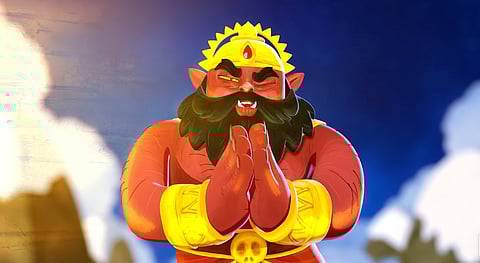

We had a conversation with Anirban Paul about where stories really begin, not with a fixed idea, but with a feeling that lingers. His films, BASHA and Monkey & Demon, may appear worlds apart in tone, one quiet and reflective, the other playful and chaotic, but they share the same starting point.
When you look at BASHA and Monkey & Demon films today, do you see them as two separate projects or as parts of the same ongoing conversation with yourself?
BASHA is quieter and more introspective, rooted in memory and resilience. Monkey and Demon are more direct and confrontational in their expression. But at their core, both explore similar questions about survival, belief, and human resilience. Even though they differ in tone, they come from the same place within me, just expressed in different ways.
Every film begins somewhere - sometimes with an idea, sometimes with a feeling. What was the starting point for each of these films? Was it a story you wanted to tell, or an emotion you wanted to explore?
I tend to trust emotions more than ideas at the beginning. "BASHA" emerged from a quiet, lingering sense of loss and stillness, akin to a memory that refuses to fade. The narrative gradually took shape around that feeling.
In contrast, "Monkey and Demon" started with a playful impulse, embodying the joy of chaos, rhythm, and timing. It was about exploring humor through movement and exaggeration, almost like composing a piece of visual music. For me, stories serve as a means of negotiating with emotions, attempting to understand them without fully resolving them.
Did either of the films surprise you while you were making it - becoming something different from what you first imagined?
Both films surprised me, but in very different ways. "BASHA" actually started as a much smaller concept. Initially, I thought it would only be a 5-minute short. However, as I continued to work on it, the world and characters began to grow, leading the story to expand beyond my original plans.
In contrast, "Monkey and Demon" surprised me by pushing itself to be more exaggerated and playful. The timing and rhythm evolved, making the film more energetic than I had initially imagined. I truly enjoy that unpredictability when a film starts to take on its own shape beyond the initial idea.
Watching both pieces, there’s a sense of shift - in tone, pacing, or even intent. What changed between the two? Was it your approach, your mindset, or something else entirely?
With BASHA, I was more instinctive and patient with the process. I allowed the film to grow slowly, without trying to control it too much. For Monkey and Demon, I had a clearer sense of timing and structure. Since it’s a slapstick comedy, I became more conscious of rhythm, pacing, and precision especially in how each moment lands. So the shift wasn’t just in tone, but in awareness. I was still following instinct, but more aware of the choices I was making.
Animation gives you control over every frame - every movement is intentional. How do you decide what to show and what to hold back when telling a story?
That control is actually a bit deceptive, just because you can show everything doesn’t mean you should.
For me, it’s always about tension between what’s visible and what’s implied. If you show too much, the audience stops participating. If you hold back just enough, they begin to fill the gaps themselves and that’s where the film becomes more personal.
So the decision often comes down to intention. What does the moment really need? Sometimes it’s a very precise action, and sometimes it’s restraint, a pause, a cut, or even an absence.
In a way, storytelling in animation isn’t just about creating movement, but about choosing where not to move, where not to explain. That balance is what gives a film its rhythm and its depth.
Are you someone who plans every beat through storyboards, or do you leave space for discovery while animating?
In creating these films, I didn’t rely heavily on detailed storyboards. I typically have a story structure in mind, but I find that the process is more straightforward if I simply jot down a few rough panels when I get an idea. This approach keeps the film flexible and allows the story to shift and evolve, sometimes in unexpected ways. I find this more exciting because I am discovering the film as I create it, rather than just following a fixed plan.
There’s always a balance between technical precision and emotional impact. When working on these films, what mattered more to you - getting the animation “right” or making the viewer feel something?
Technical precision is important, but only as long as it serves the emotion. A perfectly executed shot that feels empty doesn’t stay with you, but even an imperfect moment can feel real if the emotion lands.
So I don’t really see it as a strict choice, technique is just a tool. If it helps the feeling come through, it matters. If not, I’m okay letting it be a little rough.
Could you walk us through your process, from the initial spark to the final frame? Where do you spend the most time: thinking, sketching, or refining?
It usually starts with a vague feeling or an image that stays with me. I spend time just thinking about it, letting it settle before I touch anything.
Once it feels clear enough, I move into rough sketches not to finalise, but to explore rhythm, movement, and mood. That phase is very loose, like thinking on paper. Alongside that, I spend a lot of time on environment studies, character design, and developing the film’s visual stylisation, because these decisions define the tone and emotional language of the film.
That pre-production phase is where most of the real work happens for me, understanding what the film is, how it should feel, and how every element supports that.
By the time I move into animation, it becomes more about execution and fine-tuning bringing those decisions to life through timing and performance.
So if I had to choose, I spend the most time before the animation even begins, figuring out what the film wants to be.
Having spent a decade in animation, how do personal projects like these differ from your professional work?
The biggest difference between professional work and personal projects is the balance of freedom and responsibility.
In professional environments, you are solving problems for others. There are specific briefs, timelines, and expectations to adhere to, and you are part of a larger system. Your role is to ensure that everything functions smoothly within those parameters.
In contrast, personal projects lack a predefined brief to lean on. Every decision, whether good or bad, is solely yours. This process can be more uncertain and sometimes slower, but it is also more authentic. You are not just executing tasks; you are questioning everything, including your own instincts.
While professional work helps sharpen your skills, personal projects are what truly reveal your unique voice.
Looking at both films side by side, what do they reveal about you as a storyteller today?
I think they reveal that I’m still searching more than concluding.
While both films have very different tones, they are driven by the same curiosity to understand human behavior, emotions, and contradictions without oversimplifying them.
They also reveal that I don’t like to stay in one space for too long. I’m constantly shifting between tones, styles, and ways of telling a story.
So in a way, they reflect where I am right now - experimenting, taking risks, and trying to understand what kind of storyteller I want to become.
Many young animators feel pressure to make something “perfect.” What would you tell them after making these films?
I think “perfect” is one of the most unhelpful goals you can have.
If you wait for things to be perfect, you’ll either never finish, or you’ll end up making something that feels lifeless. Most of what you learn actually comes from finishing things, not polishing them endlessly.
With both these films, a lot of decisions came from just moving forward, even when things felt uncertain or incomplete.
So I’d say, focus on making something honest, not perfect. Imperfections are usually where the character of the film comes from.
If someone is just starting, what should they focus on more?
Focus on finishing projects, even if they are just small ideas. Completing them teaches you much more than continually starting new ones.
Pay attention to how people move, pause, and react. Good animation comes from observing life, not just from learning software.
Most importantly, stay curious. Skill will develop over time, but curiosity is what keeps your work vibrant and engaging.
Lastly, watch a variety of films - animation, live-action, and everything in between. The more you expose yourself to different storytelling styles, the more your own voice will begin to take shape.
If you had to describe your journey in animation not through words, but through a single motion or gesture - what would it look like?
It resembles a line being drawn, erased, and redrawn as it progresses.
It’s not a perfect stroke, but one that continually adjusts itself.
That’s how the journey feels to me: imperfect, yet gradually taking shape.
